Revolutionary Drawing Room
Wednesday 9th June 2021, 7:30pm-10:00pm
Pinner Parish Church
Memorial Concert: Donizetti, Haydn, Schubert Quartets
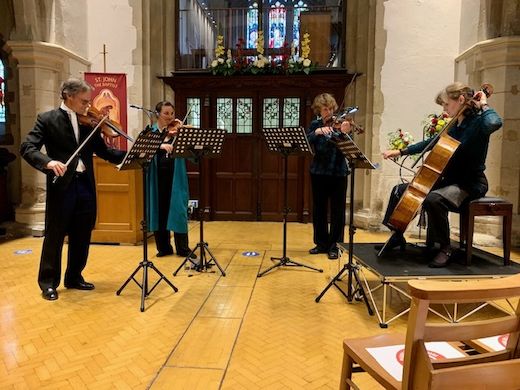
ADRIAN BUTTERFIELD (violin)
DOMINIKA FEHÉR (violin)
RACHEL STOTT (viola)
RUTH ALFORD ('cello)
Donizetti
String Quartet No.7 in F minor (1819)
Allegro vivace; Adagio ma non troppo; Presto; Marcia Lugubre, Maestoso
Haydn
String Quartet in D major Op.76 No.5 (1797)
Allegretto; Largo Cantabile e mesto; Menuetto Allegro; Finale Presto
INTERVAL
Schubert
String Quartet No.14 in D minor D.810 (‘Death and the Maiden’) (1824)
Allegro; Andante con moto; Scherzo Allegro molto; Presto
Programme note by Rachel Stott:
“I would wish to compare Haydn’s quartets to the moon, the light of which penetrates a dark room at night. When one plays more modern composers such as Beethoven and Mendelssohn ... light fills the room, there is an explosion of ecstasy ... and then suddenly the simpler compositions, just as fresh, original and full of humour, are forgotten and no longer spoken of.”
So wrote Johann Simon Mayr, teacher of the young Donizetti. The Revolutionary Drawing Room’s concert on 9th June spans this critical period in the history of music, when 18th-century refinement gave way to the revolutionary zeal of the romantic period. Haydn’s string quartet Op 76. No.5, composed in 1797, represents the summit of his achievement in the medium he had pioneered 40 years earlier. Schubert and Donizetti, born that same year, were educated in the classical tradition but discovered their distinctive voices in the years following the Napoleonic era, when music was finding new forms and sources of inspiration. Donizetti’s string quartet No. 7 is a programmatic work, composed on the death of the Marchese Giuseppe Terzi, while Schubert’s famous Death and the Maiden quartet, takes its name from the song on which he based variations for the slow movement.
The Revolutionary Drawing Room is that rare group, a string quartet that performs late 18th and 19th century repertoire with a sound derived from the beauty and flexibility of gut strings. The political upheavals of the time were matched by a breathless pace of change and the forging of new styles, forms and tastes both in the music and in the instruments used. The musicians use original bows, or modern copies, and often employ more than one in a concert depending on the range of repertoire.
The name 'Revolutionary Drawing Room' refers to the revolutionary years in Europe between 1789 and 1848. The 'drawing room' (the name deriving from the earlier 'withdrawing room') was where chamber music was performed in Georgian times, in the houses of musicians and their patrons.
The ensemble, founded in 1990, has performed in Canada, Germany, Holland, Austria, Switzerland, Denmark and Ireland as well as across the UK and has recorded for CPO (Donizetti and Boccherini quartets) and the BBC (Mendelssohn Octet). Recordings include Mozart's Clarinet Quintet with Colin Lawson on the Clarinet Classics label and ‘A Viennese Quartet Party’ on Omnibus Classics.
“Their interpretation has a freshness of sound and a subtle spontaneity that is doubly enhanced by the colourful nuance and bright rhythm in very good taste.
— Repertoire, France
Adrian Butterfield is a violinist, director and conductor who specialises in performing music from 1600-1900 on period instruments. He is Musical Director of the Tilford Bach Festival and Associate Director of the London Handel Festival and regularly directs the London Handel Orchestra and London Handel Players as well as working as a guest soloist and director in Europe and North America. He has led The Revolutionary Drawing Room for 25 years. He is Professor of Baroque Violin at the Royal College of Music in London, gives masterclasses in Europe and North America and has taught at Dartington and Pro Corda Baroque. He also directs an annual baroque project with the Southbank Sinfonia.
PMF Director Anthony Pinching talked with Adrian Butterfield recently. The interview is in three parts, totalling just under 22 minutes, which we'll call Beginning, Middle, and End.
Hungarian violinist Dominika Fehér was born into a musical family and has always had a passion for chamber music. During her studies at the Franz Liszt Music Academy Budapest she had regular coaching with members of the Bartók and Kodály Quartets as well as János Rolla, the leader of the Franz Liszt Chamber Orchestra. Upon completing her Masters degree with highest honours, Dominika was awarded the Weingarten Scholarship to study with Oistrakh pupil Rimma Sushanskaya at the Royal Birmingham Conservatoire, where she later became a Junior Fellow as a member of the Bantock Quartet. While at the Conservatoire, she developed a passion for early music under the guidance of Margaret Faultless, Lucy Russell and Oliver Webber, and has become a sought-after performer specialising in historically informed performance practice of 17th – 19th century music.
Rachel Stott is a viola player and composer. She played for many years with the Orchestra of the Age of Enlightenment, London Classical Players and other period instrument orchestras while also exploring new music with Music Projects of London, Ensemble Exposé and the New Music Players. She performs with chamber music groups The Revolutionary Drawing Room, The Bach Players and Sopriola and explores repertoire for viola d’amore with both contemporary and baroque ensembles. Rachel’s compositions have been performed at the London South Bank, Wigmore Hall, St John’s Smith Square, in UK festivals and abroad in Europe, America and Japan.
Ruth Alford has established herself as a well-respected chamber musician and continuo-cellist with many ensembles and chamber groups in London. She graduated from Manchester University with an honours degree in music and the Proctor Gregg Performance Award, having studied with Bernard Gregor-Smith and the Lindsay Quartet. Further studies followed at the Royal Academy of Music, London with David Strange, the Amadeus Quartet, Sidney Griller, Jenny Ward-Clarke and William Pleeth. During this time she gained performing experience in a variety of musical genres ranging from solo classical recitals to jazz and music theatre. Ruth still thrives on a diverse musical diet, from Baroque to Contemporary, as well as sharing her enthusiasm for music through various educational outlets. Ruth still thrives on a diverse musical diet, from Baroque to Contemporary, as well as sharing her enthusiasm for music through various educational outlets.
.
This item is currently unavailable
Website by Beachshore