Seminar & Clavichord Concert
Monday 8th June 2026, 12:30pm-2:30pm
Pinner Parish Church
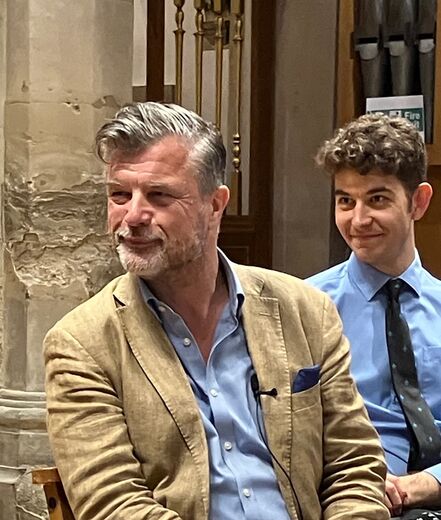
Petroc Trelawny interviews PMF artists, and Julian Perkins performs Bach's Attick
C. F. Pollarolo (c1653 - 1723)
Capriccio in C major
D. Buxtehude (c1637 - 1707)
Suite d'amour in D minor, BuxWV 233
Allemanda d'amour - Courant - Sarabande d'amour
Sarabande - Gigue
J. Pachelbel (1653 - 1706)
Aria and 6 Variations in F major, P. 195
from Hexachordum Apollinis (c1699, Nuremberg)
G. Böhm (1661 - 1733)
Suite in F minor
Allemande – Courante – Sarabanda – Ciaccona
J. S. Bach (1685 - 1750)
Fantasia in G minor, BWV 917
Fugue in G minor, BWV 1000
Prelude and Fugue in F major, BWV 856
from Book 1 of Das wohltemperierte Klavier
C. P. E. Bach (1714 - 1788)
Fantasia in C major, Wq. 61/6, H. 291
Presto di molto – Andante – Presto di molto –
Larghetto sostenuto – Presto di molto
W. F. Bach (1710 - 1784)
Polonaise in D major, F. 12
J. S. Bach
Chromatic Fantasia and Fugue in D minor, BWV 903
The new format this year combines our usual Seminar, the inimitable Petroc Trelawny in the Chair, with a delightful concert by Julian Perkins on Clavichord, JS Bach’s favourite instrument, exploring his predecessors & offspring.
The Seminar Panel comprises: Paul Greally, Assistant Organist at Westminster Abbey, and erstwhile organ scholar at Pinner Parish Church; Jacqueline Thomas, founding cellist of the acclaimed Brodsky Quartet (3,000 performance & 70 recordings to date!); James Gilbert, clarinettist of Ensemble Renard (and recently appointed principal clarinet of BBC Concert Orchestra); and Marco Galvani, award-winning composer and educator based in London, and composer of Eternity, commissioned for the Pinner Music Festival Choir for PMF26. We shall hear about the music and the musicians and, as usual, explore interesting connections …
Petroc Trelawny’s best-selling book ‘Trelawny’s Cornwall – a Journey Through Western Lands’, published by Weidenfeld and Nicholson, is out now in paperback. ‘Petroc Trelawny’s Classical Puzzle Book’ was published by Quarto last year. Petroc is one of the best-known voices on BBC Radio Three - where after fourteen years presenting the daily Breakfast programme, he now hosts In Tune. Last year he was commentor for the Remembrance Sunday service at the Cenotaph on BBC1 and previously was part of BBC Television’s coverage of the Coronation of King Charles III and the funeral of Her Majesty The Queen. He has presented BBC Proms on radio and television for twenty-five years and introduces the annual live BBC broadcast of the Vienna Philharmonic New Year’s Day Concert. In 2023 he hosted BBC Television’s ‘Cardiff Singer of the World’ for the thirteenth time. He has presented the international telecast of Eurovision Young Musician to more than two dozen countries from Edinburgh and hosted Eurovision Choir live from Gothenburg. He presents performances by the Royal Ballet shown in cinemas around the world, and anchors note-by-note coverage of the Leeds Piano Competition for Medici.tv.
Raised in west Cornwall, his early career includes broadcasting in Hong Kong for the British Forces Broadcasting Service, being part of the launch team for Classic FM and London News Radio, presenting breakfast on BBC Radio Manchester, and working as a presenter for RTE in Ireland. He is President of the Lennox Berkeley Society, Luton Music and the Three Spires Singers. As well as classical music he loves books, travel, food and wine, cinema and theatre. He is a Trustee of the Hall for Cornwall, Truro and a member of English Heritage’s Blue Plaque panel.
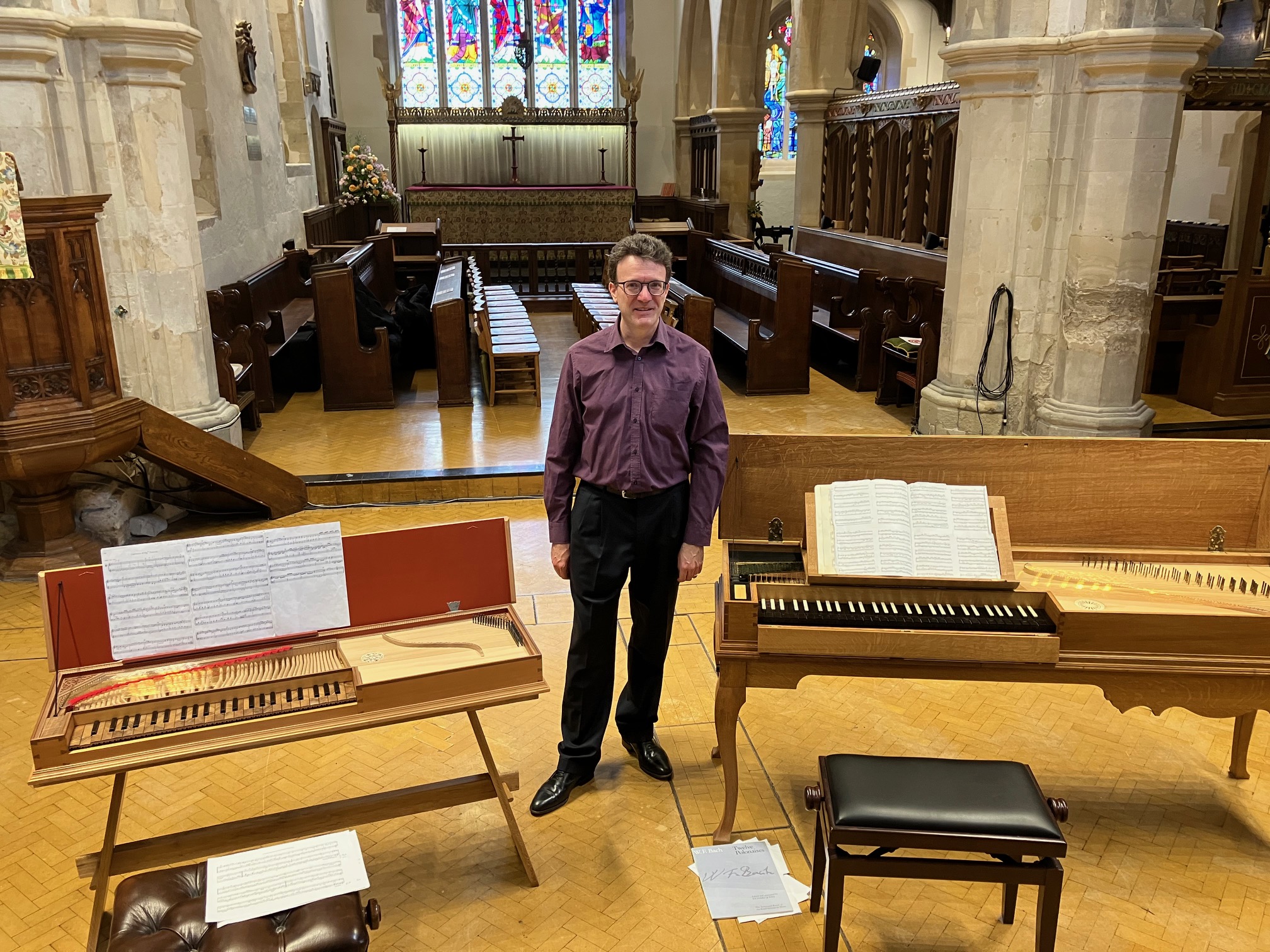
Dubbed ‘‘The Indiana Jones of Early Music’’ by BBC Radio 3, Julian Perkins brings a dynamic and adventurous spirit to all his music-making. Based in the UK and of dual British-Italian citizenship, he enjoys a busy and varied international career as a solo keyboard player, chamber musician and conductor/director. He is delighted to be returning to the Pinner Music Festival following his performance of keyboard duets with Emma Abbate last year.
Julian has broken new ground at over a dozen international festivals by giving solo clavichord recitals. He has also performed for the Boston Clavichord Society in the USA and the Magnano International Symposium in Italy, while his pioneering disc of duets for two clavichords with Terence Charlston saw no fewer than eight world premières with works by composers including Iain Farrington, Nicola LeFanu, Peter Maxwell Davies and Héloïse Werner. His last solo clavichord disc, Handel's Attick, was Instrumental Choice in BBC Music Magazine in August 2023. He is now planning to record much of today’s programme, celebrating what was purportedly Bach’s favourite keyboard instrument. Please talk to Julian if you would like to know more about this self-funded project.
As a boy, it is said that Johann Sebastian Bach would creep into his elder brother’s study ‘on moonlit nights’ to copy a music book that he had been banned from seeing. The music that he copied includes composers featured in today’s programme, all of whom had a profound effect on him. Julian likes to imagine Bach playing this music on what was reputedly his favourite keyboard instrument – the clavichord. It certainly played a central role in the life of his son, Carl Philipp Emanuel, whose Fantasia in C major embodies the varied stylistic traits of ‘empfindsamkeit’ – loosely translated as the ‘sentimental style’.
As a harpsichordist and fortepianist, Julian has often performed at the Salzburg Festival and appeared as a soloist with ensembles including the Bayerisches Staatsorchester, BBC National Orchestra of Wales, Florilegium, Orchestra of the Age of Enlightenment, Orchestra of The Sixteen and Royal Northern Sinfonia. He often directs from the keyboard, and is Artistic Director of Portland Baroque Orchestra in Oregon and Cambridge Handel Opera in the UK. Other ensembles he has directed/conducted range from the Academy of Ancient Music, Croatian Baroque Ensemble, Deutsche Händel-Solisten, New London Singers and Tesserae Baroque to the Charlotte Symphony Orchestra & Charlotte Master Chorale, Northern Chamber Orchestra, Orchestra of Welsh National Opera and St Paul's Sinfonia. Passionate about education, Julian has directed Baroque and Classical projects for the Oregon Bach Festival and at institutions including The Juilliard School in New York, Royal College of Music in London and the Venice Conservatory.
Believing that performing musicians have much in common with athletes, Julian admires Novak Djokovic's discipline – and aims to emulate various aspects of his lifestyle. His own sporting prowess, however, is somewhat limited, and he invariably loses at football to his pre-teenage twin sons.
This item is currently unavailable
Website by Beachshore